
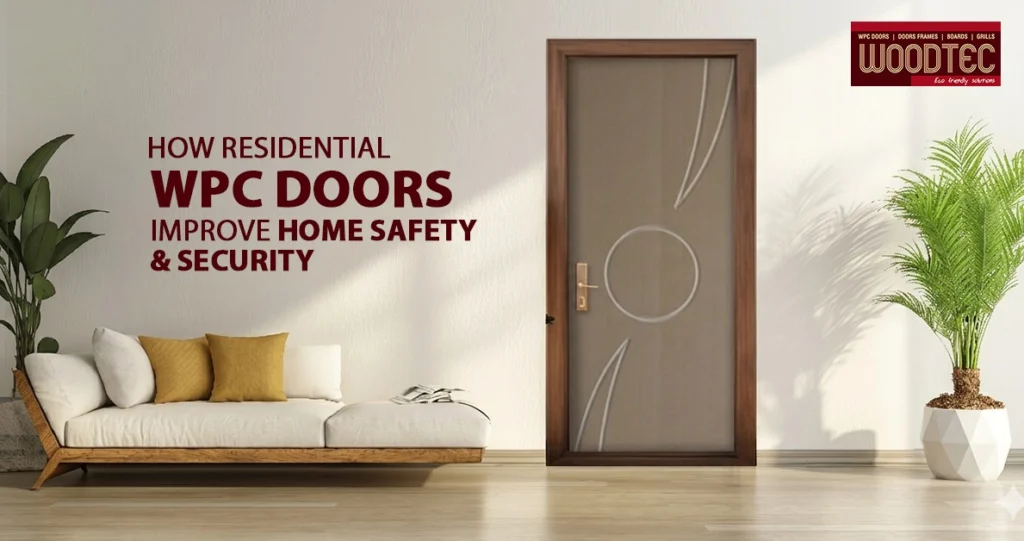
When we evaluate the security and longevity of a home, the focus usually lands on surveillance or reinforced locks. Yet, the foundational material of the door itself, the substrate, is what determines whether those security features actually hold up over time. While timber has been the historical standard, its organic vulnerabilities often compromise a home’s safety. This is why WPC doors have moved from being a niche alternative to a primary choice for high-end residential projects.
The Problem with Organic Decay
The most significant security risk in traditional wood is often invisible: termite and borer infestation. These critters eat away at a door’s insides, making the outside seem perfectly fine even as the door’s strength disappears. Leading WPC door makers have struggled with this problem, working hard to find a fix. Their answer? Blending wood fibers with dense polymers, creating a material that’s impervious to biological threats.
WPC doors don’t attract any kind of pests, which means the door remains strong and sturdy throughout its lifecycle without needing toxic chemical treatments.
Fire Performance and Passive Safety
Natural wood easily catches fire, whereas WPC doors are made with fire-retardant additives. In contrast, WPC door manufacturers in India are now engineering products with fire-retardant additives.
Dimensional Stability in Variable Climates
In many parts of India, extreme humidity causes wooden doors to swell, warp, or sag. When a door loses its shape, deadbolts misalign and latches fail to catch, leaving the home vulnerable. WPC doors manufacturers suggest WPC doors are 100% waterproof and moisture-resistant, they maintain their exact dimensions regardless of the weather. Whether installed in a damp bathroom or as a main entrance, the door stays perfectly square within its frame.
Long-Term Reliability vs. Maintenance
The “security” of a door shouldn’t depend on how often you sand or polish it. Wood needs regular care to stave off rot and cracking, both of which can ultimately compromise its structural integrity. Opting for WPC doors eliminates this maintenance hassle. WPC doors are much more resistant to splitting and damage from impacts than traditional wood, and they demand almost no upkeep to remain functional. This dependability makes them a smart choice for anyone looking for a long-lasting solution for their home.
Conclusion
Investing in WPC doors is a practical way to ensure your home remains safe and secure. These doors don’t rot, they don’t burn easily, and they certainly don’t feed pests. For any residential project where long-term reliability is the priority, WPC offers the aesthetic of wood without the inevitable structural headaches. It’s the most logical substitute on the market today for a house built to last.
FAQs
1. What are WPC doors and why are they better than wooden doors?
WPC doors are made from a combination of wood fibers and thermoplastic materials. Unlike traditional wooden doors, WPC doors are highly durable, making them a better long-term option for residential homes.
2. Are WPC doors safe for residential homes?
Yes, WPC doors are considered very safe for homes. They are fire-retardant, termite-resistant, and moisture-proof, which helps maintain the door’s strength and durability over time. Many homeowners choose WPC doors to improve the overall safety and reliability of their home entrances and interiors.
3. Do WPC doors require maintenance?
One of the biggest advantages of WPC doors is their low maintenance. Unlike wooden doors, they do not require polishing, oiling, or chemical pest treatments. This makes them a practical choice for homeowners looking for long-lasting doors with minimal upkeep.