If you’ve ever lived through a monsoon in India, you know the sound of a “swelling” house. It’s that annoying creak when a wardrobe door refuses to shut, or the way a kitchen cabinet door suddenly feels two sizes too big for its frame.
For decades, we’ve just accepted this as part of life. We’ve been told that wood “breathes,” which is a poetic way of saying it’s soaking up water like a sponge and slowly rotting from the inside out. But in modern home design, we don’t have to settle for materials that self-destruct every time the humidity hits 80%.
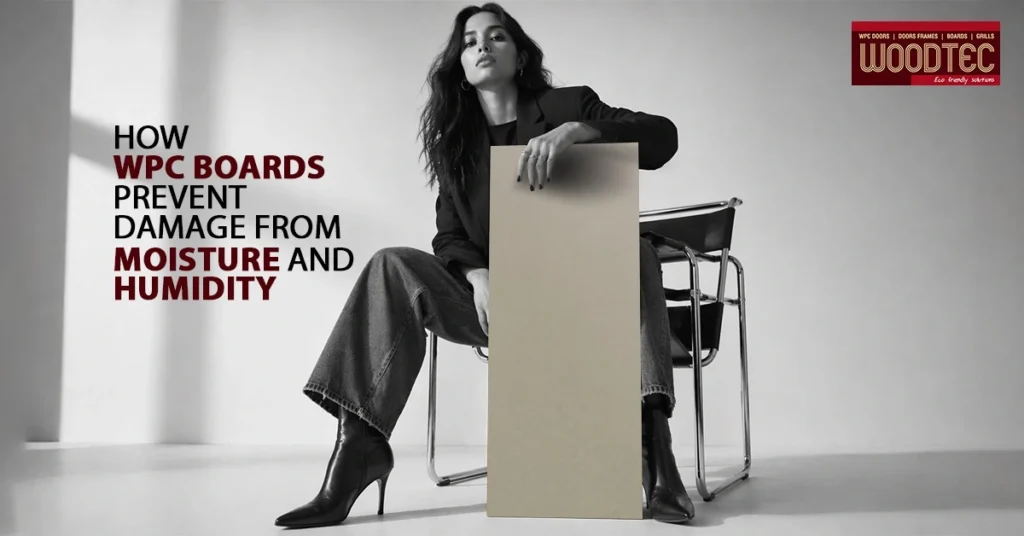
This is exactly where WPC boards (Wood Polymer Composite) have changed the game. If you’re tired of watching your expensive interiors warp, here is a look at how this material actually fights off moisture.
The “Sponge” Problem with Plywood
Traditional plywood is made of layers. These layers are held together by glue, and wood fibers are naturally porous. Think of them like tiny straws. When the air gets humid, those straws suck in moisture. The glue starts to fail, the layers pull apart (delamination), and before you know it, your “premium” plywood is bubbling.
WPC boards don’t have straws. Because they are a fusion of wood fibers and recycled thermoplastics, the material is dense and non-porous. It doesn’t “breathe” in the moisture because there’s literally no room for the water to go. You could submerge a WPC board in a tank of water for a month, pull it out, and it would be the exact same dimension as the day you put it in.
Why Your Kitchen Needs This Most
If there is one room that is a graveyard for traditional woodwork, it’s the kitchen. Between the steam from cooking, the dampness under the sink, and the daily floor mopping, your cabinets are under constant attack.
Most homeowners find that their under-sink area starts to smell musty after a year or two. That’s the smell of rotting wood. Switching to a kitchen WPC board for your cabinetry fixes this permanently. A kitchen WPC board doesn’t just resist water; it ignores it. You can literally wash your kitchen floor with a pipe, and if the water splashes the cabinets, it just beads off. No swelling, no mold, and no expensive replacements every five years.
Beyond Just Boards: The Versatility of the WPC Sheet
When we talk about moisture protection, we aren’t just talking about the heavy structural stuff. Sometimes you need a thinner, more flexible solution for wall paneling or decorative work in a damp basement or a bathroom.
This is where the WPC sheet comes into play. These sheets offer the same moisture-proof DNA but are calibrated for a smoother finish. If you’ve ever seen a beautiful decorative wall panel start to peel or flake because of a damp wall behind it, you’re seeing a failure of traditional materials. Using a WPC sheet ensures that even if there is “seepage” in the brickwork, your interior finish stays pristine. It acts as a waterproof shield for your aesthetics.
The Hidden Benefit: Termites Hate Water-Resistant Tech
There’s a direct link between moisture and termites. Termites love damp, soft wood. By using WPC boards, you’re effectively removing the “welcome mat” for pests. Since the boards don’t absorb water, they don’t soften, and since they contain polymer, they offer zero nutrition to a termite. It’s a double layer of protection for your home investment.
Final Thoughts
We invest a lot of heart (and a lot of money) into our homes. It’s heartbreaking to see that investment ruined by something as simple as a humid summer or a leaky pipe.
Whether you are building a new home or just fixing up a damp corner, choosing WPC boards over plywood isn’t just a technical choice; it’s a stress-relief choice. From the heavy-duty structural WPC board to the specialized kitchen WPC board, you’re buying peace of mind.
Stop worrying about the weather forecast and start building with something that’s actually built to last. Your home deserves to stay in shape, no matter how high the humidity climbs.
FAQs
1. Can I use a WPC sheet for wall paneling in a room with seepage?
Seepage is a nightmare for interior decor because it causes paint to flake and plywood to rot from the back. A WPC sheet is the perfect “barrier” solution. Because it is moisture-impermeable, you can install it on damp walls without worrying about the panel warping or the finish peeling off. It essentially shields your room’s interior from the moisture trapped in the bricks.
2. Why is a kitchen WPC board recommended specifically for the area under the sink?
The area under the sink is the most neglected part of a kitchen. Small, unnoticed leaks from the plumbing often lead to the wood rotting and emitting a foul, musty smell. Using a kitchen WPC board for the carcass of these cabinets ensures that even if a pipe leaks for a week, the board won’t swell or grow mold. You just fix the leak, wipe the board, and you’re done.
3. Does high humidity cause WPC boards to expand like natural wood?
Natural wood “breathes,” expanding in the monsoon and shrinking in the summer, which leads to cracks in your furniture. WPC boards have excellent dimensional stability. They don’t react to the humidity in the air, meaning your drawers won’t get stuck and your cabinet doors will always shut perfectly, no matter how much it rains outside.
4. Will the moisture trapped in the boards lead to fungal or mold growth?
Mold needs organic, damp material to grow. Since a Woodtec WPC board doesn’t absorb water and is a mix of polymer and wood fiber, it doesn’t provide the “food” that fungus needs. This makes it a much more hygienic choice for damp areas like bathrooms or poorly ventilated kitchens.