If you’ve walked into a hardware store lately or talked to an interior designer, you’ve probably noticed that the conversation has shifted. A few years ago, everyone was obsessed with “teak finish” or “solid mahogany”. ” But in 2026, the reality of home maintenance has caught up with us. We’re all busier, labour costs are higher, and the climate is getting more unpredictable.
This is exactly why WPC doors are no longer just a “budget alternative”; they have become the first choice for modern homes. If you’re still on the fence about whether to go with traditional wood or a WPC solid door, let’s look at why the smart money is moving toward composites this year.
The Death of the “Warping” Door
We’ve all been there: It’s the middle of a heavy monsoon, and you’re practically wrestling with your bedroom door just to get it to click shut. Wood is a natural material that reacts to the air around it. It swells when it’s humid and shrinks when it’s dry.
A WPC solid door simply doesn’t care about the weather. Because it’s a high-density fusion of wood fibres and polymers, it’s dimensionally stable. Whether you live in a humid coastal city or a dry inland region, a WPC solid door stays the exact same shape. You won’t have to call a carpenter every two years to “shave down” the edges of your doors just so they fit back in the frame.
Why Every Residential WPC Door is a “Green” Choice
In 2026, we can’t ignore the environmental cost of construction. Every time we insist on solid forest timber, we’re contributing to a massive deforestation problem. Choosing a residential WPC door is a way to get that premium, heavy feel without the guilt.
At Woodtec, our WPC doors are made using recycled wood waste and eco-friendly polymers. We’re basically taking material that would have gone to a landfill and turning it into a high-end architectural product. It’s a sustainable cycle that doesn’t sacrifice the “heft” or the quality you expect in a luxury home.
The Hygiene Factor (The “Bathroom Test”)
If you want to see where a door really fails, look at the bathroom. Standard flush doors or wooden doors in high-moisture areas eventually start to peel at the bottom. They soak up water from the floor, they grow mould, and they start to smell musty.
A residential WPC door is 100% waterproof. You could literally take a hose to it, and the water would just bead off. This makes WPC doors the only logical choice for bathrooms, kitchens, and balconies. They are non-porous, meaning bacteria and fungi have nowhere to hide. In a post-pandemic world where we care more about home hygiene, a door that can be easily washed down with soap and water is a massive advantage.
Built-in Termite Protection
In India, termites aren’t just a nuisance; they are a financial disaster. I’ve seen homeowners spend lakhs on beautiful wooden interiors only to find them hollowed out within three years.
Because a WPC solid door isn’t “pure” wood, it has zero nutritional value for termites or borers. You don’t need to do those annoying chemical injections every year. When you install WPC doors, you’re installing peace of mind. It’s one less thing to worry about on your yearly home maintenance checklist.
Design Without Limits
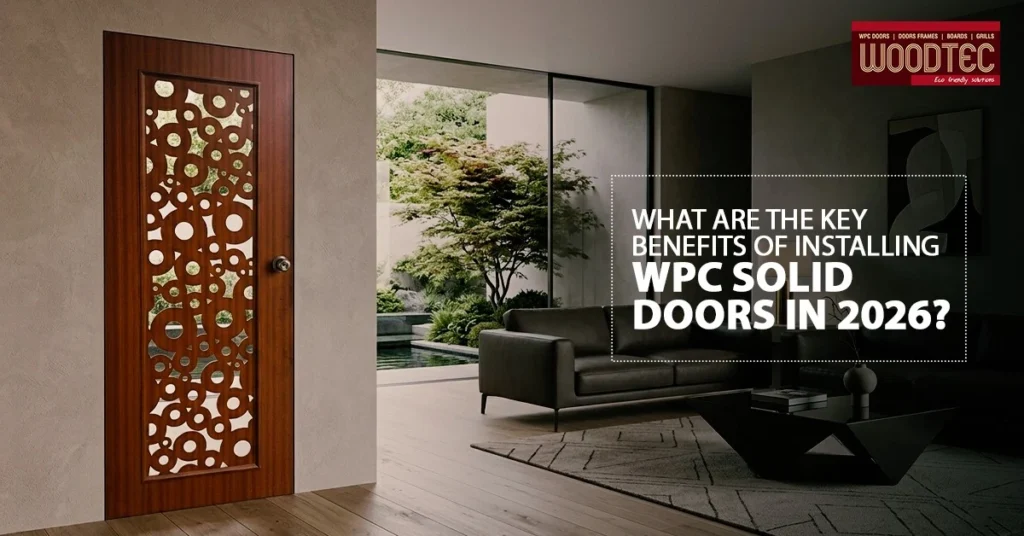
Gone are the days when composite doors looked like “cheap plastic”. The WPC solid door of today can be finished in any way you imagine. You can have deep CNC carvings for a traditional look or a perfectly smooth, matte PU finish for a minimalist apartment. They hold paint and laminates better than plywood because there’s no internal moisture trying to push the glue out.
Final Thoughts
Construction in 2026 is all about efficiency and longevity. We want things that look beautiful but don’t require us to be “slaves” to their maintenance.
Switching to WPC doors is a rare win-win. You save money on long-term repairs; you protect the environment; and you get a door that functions perfectly every single day, regardless of the season. If you’re building or renovating this year, don’t just follow the old traditions. Look at the science, look at the durability, and choose a WPC solid door that’s actually built for the future.
FAQs
Does a WPC solid door feel as heavy and sturdy as a wooden door?
Yes. One of the biggest surprises for people switching from timber is the “heft” of a WPC solid door. Unlike hollow-core flush doors, these are high-density solid units. When you close a Woodtec door, it has that satisfying, solid “thud” you expect from high-end woodwork, providing excellent sound insulation and security for your home.
Why is a residential WPC door considered a better investment than a standard flush door?
A standard flush door is often just a wooden frame with a thin plywood skin. Over time, the layers peel (delaminate), especially in humid weather. A residential WPC door is a single, solid piece of composite. It won’t peel, warp, or rot, meaning you won’t have to replace it in five years. The “lifetime cost” of WPC is much lower because maintenance is virtually zero.
Are WPC doors actually 100% waterproof for bathroom use?
Absolutely. While many doors claim to be “water-resistant”, WPC doors are entirely waterproof. Because they are a fusion of polymer and wood fibre, they don’t absorb moisture at all. You can install them in bathrooms, laundry rooms, or even as balcony doors facing heavy rain without any fear of the material swelling or growing mould.
Can I get custom designs or carvings on a WPC solid door?
Yes. Because of its solid, uniform density, a WPC solid door is perfect for CNC routing. You can achieve deep, intricate carvings that stay sharp and clean. Whether you want a traditional look with floral patterns or a minimalist residential WPC door with clean geometric grooves, the material handles fabrication beautifully and takes paint or laminates with ease.