If you’ve ever walked through an old heritage home, you’ve probably stopped to admire those intricate wooden lattice screens. They’re beautiful, no doubt. But if you look closer at a wooden jali that’s been around for a few years, you’ll usually see the reality: chipped paint, soft rot at the corners, or fine cracks where the wood has simply given up on the weather.
For a long time, we used wood because we didn’t have a better way to get that “lace-like” architectural look. But today, the WPC jali has stepped in to solve the massive headache that comes with maintaining traditional carvings. At Woodtec, we see people switching every day, and it isn’t just because of the price; it’s because people are tired of “babysitting” their home decor.
The Problem with the “Old Way”
Traditional wooden jalis are high-maintenance. Wood is a living material; it reacts to everything. If the sun is too harsh, it cracks. If the monsoon is too heavy, it swells. And if you’re unlucky enough to have termites, your beautiful investment literally becomes a snack.
This is where a WPC jali (Wood Polymer Composite) changes things. By mixing wood fibers with high-grade polymers, you get a material that looks like wood but behaves like stone. It’s solid, it’s heavy, and most importantly, it’s completely indifferent to the weather. You can install a WPC jail in a balcony that faces direct rain and sun, and five years later, it will still look exactly the same.
Precision is the Real Hero
One thing that really separates a modern WPC jali design from manual wood carving is the level of detail you can achieve. In the past, if you wanted a very thin, intricate pattern in wood, the material became fragile. One wrong move and a piece would snap off.
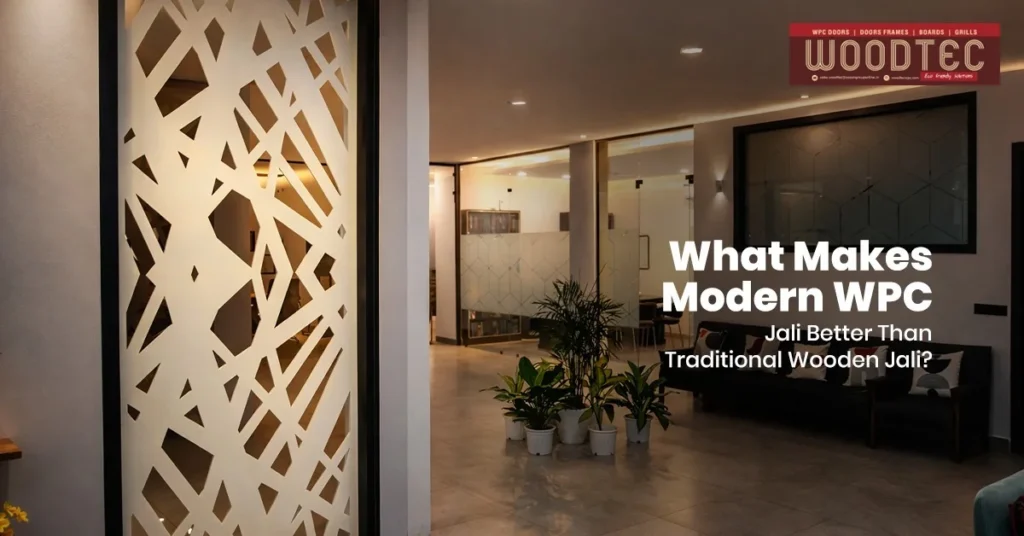
With a WPC jali design, we use high-speed CNC machines. Because the material is so dense and uniform, we can cut razor-sharp geometric patterns or flowing floral designs that are perfectly symmetrical. Every line is clean. Every curve is smooth. If you are going for a modern WPC jali design with those crisp, minimalist lines that are so popular in luxury apartments today, you just can’t get that same “perfection” with hand-carved wood.
Why Builders are Swapping Out Metal for WPC Grills
It isn’t just wood that’s being replaced. Many homeowners are now choosing WPC grills over traditional iron or steel bars for their windows and partitions.
Why? Because metal rusts. If you live in a coastal area or a city with high pollution, you know the cycle: scrape off the rust, prime it, paint it, and repeat every two years. WPC grills give you a much more sophisticated, “furniture-like” look without the threat of corrosion. They provide privacy and a sense of security while looking like a piece of art rather than a prison bar.
Where Can You Actually Use Them?
The beauty of the WPC jali is that it’s a “multi-tasker.” We have clients using them in ways that wood just couldn’t handle:
- Mandir Backgrounds: With backlighting, a WPC jali design creates a stunning, peaceful glow that makes the prayer room feel special.
- Duct Covers: Most buildings have ugly plumbing pipes visible in the shafts. A WPC jali is the perfect way to hide those pipes because it won’t rot from the dampness often found in those areas.
- Exterior Facades: You can wrap a whole building in WPC grills to create shade and a unique architectural look that stands up to the sun.
Final Thoughts
We all love the look of traditional craftsmanship, but in 2026, nobody has the time to spend their weekends sanding and repainting their window screens.
Choosing a WPC jali means you get the best of both worlds. You get that warm, inviting texture of wood and the freedom to pick any WPC jali design you can imagine, but you also get the peace of mind that comes with a “fit it and forget it” material. If you’re building a home that’s meant to last a lifetime, why would you choose a material that starts dying the moment it’s installed?
It’s time to move past the limitations of the past and embrace a smarter way to decorate. Your home deserves to look beautiful without becoming a chore.
FAQs
Q1. Will a WPC jali get brittle or crack if exposed to direct sunlight?
No. This is a common concern with cheap plastic, but Woodtec WPC jali panels are manufactured with UV stabilizers. Unlike traditional wood, which dries out and develops fine cracks (splintering) under the sun, WPC remains flexible enough to handle temperature shifts without becoming brittle or losing its structural strength.
Q2. Is it difficult to clean the dust out of a modern WPC jali design?
Intricate carvings are notorious for catching dust. With wooden jalis, you have to be careful not to use too much water, or the wood might swell. With a modern WPC jali design, maintenance is easy. Since the material is 100% waterproof, you can use a damp cloth, a soft brush, or even a light spray of water to keep the patterns looking sharp and clean.
Q3. Can I paint WPC grills to match my room’s color theme?
Yes. While many people love the natural “woody” look of our WPC grills, they take paint exceptionally well. You can use high-quality PU paints or duco finishes to match your interior. The best part? Unlike wood, the paint won’t peel off due to internal moisture, because the board itself stays bone-dry.
Q4. Does a WPC jali cost more than a wooden one?
Initially, the cost is quite comparable to high-quality seasoned wood. However, when you factor in the “lifetime cost”, zero polishing, no termite treatments, and no repairs, the WPC jali ends up being significantly cheaper. It’s a one-time investment that doesn’t demand a yearly maintenance budget.